We have never had full control over how a brand is perceived. We made the ads, the website and the sales decks, but the customer’s decision was often shaped by a friend’s recommendation, an industry article or a comment on a forum. Anyone who works in marketing knows this: your brand is less what you say about it and more the sum of what other people say.
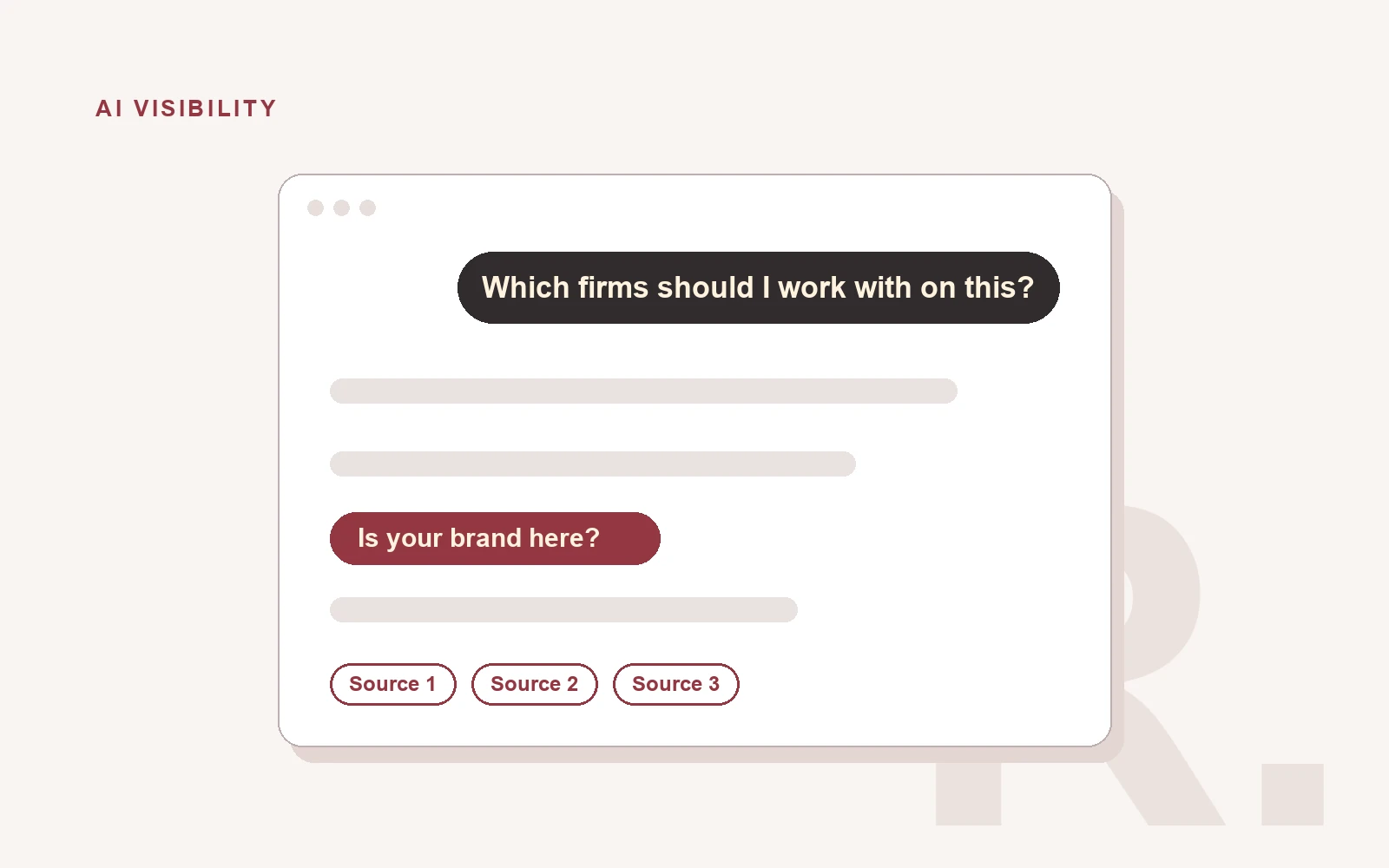
Now there is a new voice in that conversation. People no longer put their questions only to search engines; they also ask AI assistants like ChatGPT. They ask things like “Who should I work with on this?” or “What’s the difference between these two approaches?” and get confident answers a few sentences long. Some brands appear in those answers. Others don’t.
In this piece, we want to share how we approach the question “Where does our brand show up in these answers?”
It isn’t really a new question
AI visibility sounds like a technical topic. At its core, though, it asks a question marketing has always asked: what does the customer come across when they are making a decision?
A few years ago, that question would have made us think of the store shelf, the trade show or the first page of search results. Now the answer an AI gives has joined that list. The difference is this: in search results, the customer sees ten links and chooses for themselves. In an AI answer, part of that choice has already been made for them. A few names rise to the top, a frame is set in a couple of sentences, and the customer starts thinking inside that frame.
That is why we think it makes more sense to treat this as a brand question than as an algorithm question.
Start with the customer’s question, not your brand name
Teams that get curious about this usually do the same thing first: they ask an AI about their own brand. “What does Company X do?” The answer is usually satisfactory, and reassuring.
But that is the question of someone who already knows you. What really matters is what comes up for someone who doesn’t know you yet. That person doesn’t type your brand name; they type their problem. They ask, “Why is our sales team losing deals at the proposal stage?” or “Should we hire an agency for this, or do it ourselves?”
You don’t need to look far to find these questions. The questions your sales team hears every week, the emails that arrive before a proposal, the requests that reach your support team… All of them tell you, in the customer’s own words, what they are looking for. In our view, the most valuable list of questions isn’t written in a meeting room; it takes shape inside those conversations.
Read the answers like a marketer
When you put these questions to AI assistants, we suggest reading the answers not as a customer, but as a marketer. There are a few things we pay particular attention to.
The first is whether your brand is there at all. If it is, which names it appears alongside and how it is described. That last point is often the most revealing. The answers may describe you not by the strength you want to lead with, but by whatever people talk about most when they talk about you. Being known for a side feature of your product rather than a value you have championed for years is an honest mirror of how your brand looks from the outside.
The second is what the answer is based on. Some assistants list the pages they drew on beneath their answers, and looking at those pages is very instructive. Sometimes your brand is mentioned, but the information about you comes from a competitor’s comparison article or a news story written years ago. In other words, someone else is telling your story.
The third is whether what is being said is accurate. A service you no longer offer, an old address, a sentence that confuses you with a company with a similar name… These look like small mistakes, but at the moment of decision they can shake trust.
Don’t judge by a single answer
Perhaps the most confusing thing about AI answers is that they don’t stay the same. Ask a question today and you get one answer; ask it in slightly different words a few days later and you may get another.
So there is no need to celebrate or panic over a single screenshot. It is healthier to ask the same questions at regular intervals and keep simple notes on what you see. Which question did you ask, was your brand there, how was it described, which names came up? After a few rounds, it becomes easier to tell chance from a pattern. Not showing up once doesn’t say much; the same competitors coming out on top for the same reasons every time does.
What can you do with what you find?
The real value of this exercise lies in what the resulting picture tells you about your brand. More often than not, it isn’t only about AI; it also exposes gaps in your brand story.
If your website has no clear answer to a question customers ask often, other people’s accounts will fill that gap. If your brand is described inaccurately or incompletely, the place to start is your own website and presentations. If your competitors keep appearing in certain trade publications or comparison articles while you don’t, the issue is less about visibility and more about reputation. Then it is time to think about how you can earn a voice in those publications.
You may have noticed that none of this is work you would do only for AI. Pages that answer the customer’s question clearly, consistent and up-to-date information, a presence in credible publications… These are things good marketing has always recommended. AI answers simply give us a different window on how well we are doing them.
A final note on honesty
No one in this field can promise you a place in a particular answer, or a particular position within it. Those answers aren’t written by agencies, and they aren’t written by brands. What we can do is see the picture the customer sees, tell the brand’s story more clearly and consistently, and be present in the right places.
To us, that is where the real opportunity lies. AI lets you question how your brand looks from the outside faster and more openly than before. Sometimes asking that question is worth more than any answer you get.
If you would like to look at how your brand shows up in these answers together, take a look at our AI visibility work.